Petra Haden is a prodigious singer, violinist and collaborator with the likes of The Decembrists, Yuka Honda and Bill Frisell (amongst others). In her solo career, she is a major proponent of a capella vocalese. If you found the Swingle Singers doing Bach over precious, you can banish that feeling forever by dipping into her 2005 Petra Haden Sings: The Who Sell Out, a full multi-tracked voicing of one of The Who's best albums (complete with silly advert send ups). Her 2007 recording of Journey's Don't Stop Believing was ripped off wholesale by the tone deaf stunted thirty year old autotune dependents of Glee. Here she aptly tackles a wide range of movie themes from Rebel Without A Cause to The Social Network.
I say aptly because as track 5 played out, Ennio Morricone's A Fistful of Dollars, with a beautifully pure delivery which brought tears to my eyes, I realized that this is exactly what we all try to do this as we watch our favorites with their iconic scores. Unfortunately I didn't inherit my grandfather's perfect pitch, and I can only carry a tune in the same manner and distance as a New Jersey wise-guy carries a stiff from the trunk of a stolen limo to a shallow grave in the pine barrens. Her treatment of the Psycho main theme is just the gravy, and her Superman theme is absolutely singalong (despite aforementioned vocal challenges), and reminds us that the John Williams music is really the best thing in that film which rides a stupid script (a hissy fit reversing the spin of the Earth would not turn back time, but likely tear the planet apart) kept afloat by Christopher Reeve's canny boyish charm.
She's not shy about tackling another great Herrman, his Taxi Driver score, or Nino Rota, the gallop from 8 1/2. She stoops to adding instrumentation for three of the four songs, absolutely elevating the Stephen Bishop hit penned by Dave Grusin and Alan and Marilyn Bergman, Tootsie's It Might Be You (with the great Bill Frisell on guitar); also Calling You from Baghdad Café, and the Bowie / Metheny This Is Not America from The Falcon and the Snowman. She strips back to vocal for Goldfinger, which needs a few listens to overcome the hold Shirley Bassey has on our ears.
Like a great marathon movie matinee, this album certainly sends you out into the daylight, blinking and humming the tunes.
Review: Under the Skin -- Green Men are From Mars, Redheads are From Venus
When did Scarlett Johansson become so sexy? Her voice is enough to make Joaquin Phoenix fall in love with an operating system in Her. She is the cat suited kick ass assassin Black Widow in Marvel's Avengers franchise. In Under the Skin she crawls the streets of Glasgow seducing young men whom she literally drives to abstraction.
I'll tell you when. It was in Match Point. Yes, the dreadful crime without punishment thriller in which Woody Allen totally misreads the British class system as a stand in for his usually privileged New Yorkers (jarring example: they faun over a tennis player because he's read Dostoyevsky -- the exact opposite of the practically cliché pre-Thatcher product of great British education proudly well read working class Trotskyite). Jonathan Rhys Meyers believably puts his social climbing at risk for a tortured affair with Scarlett who, for the first time for me, was fully glamorous. Up 'til then she'd been cute, kinda pretty, kinda gawky, usually deadpan funny. Match Point shifted her gears up to full va va va voom. This discovery was the one intriguing element to that film. Unfortunately, my new found appreciation of Scarlett's charms was shared by a grubby old man a few rows in front of me, who grunted lustfully every time the camera cut to her (on each and every cut, like a perverted Thelma Schoonmaker).
Under the Skin is.... hold on... I'd like to say having seen the film, I'd been told things about it I wish I hadn't... things the film itself resolutely never explains. So... dear reader... if you fancy a film that mixes themes of death, sex and alienation, lightly plotted, opaque, but filled with a series of arresting images, and with ostensible smatterings of weird/horror/science fiction genres... or, if you just need an opportunity to grunt at Scarlett looking tantalizing in a faux rabbit fur coat and tight jeans... then read no further and go see it with my recommendation but for the caveat that it is Arty with a capital A. You have been warned.
The Things which didn't spoil, but I'd have soon not known going in: Under the Skin is based on the Michel Faber novel in which an alien, in a Scarlett Johansson skinsuit prowls in a van using her wily femininity to lure young men back to a stylized demise featuring nudity and black goo. Also, some scenes were filmed with "non-actors" by hidden cameras (I didn't waste time trying to spot which ones, and difference in the end is purely academic).
The film begins with a Kubrickian sequence of lights and shapes, the 2001 monolith/stargate/light tunnel given a utilitarian re-design by Steve Jobs (and indeed it is shortly followed by a transformation sequence so filled with white light and silhouettes I thought we were briefly in an early Ipod ad). This wink to the audience (complete with the full 2001 eye close-up) is the only indication of interstellar travel. Mica Levi's nervy box of violins being rattled soundtrack stands in superbly for Ligetti (at time of publication this link will let you stream it http://pitchfork.com/advance/384-under-the-skin/).
The fate or purpose of her victims is never revealed, although some appear to be "harvested" by the sexual encounter. So, more Liquid Sky meets Eyes Wide Shut than The Man Who Fell to Earth meets Species. Although, to be perfectly fair, it is thoroughly infused with that sense of "other" that liberally peppers the works of Nic Roeg. Scarlett for her part puts this across as beautifully as Bowie did, her detachment complete as expression falls from her face each time she stops interacting with humans.
The otherness is intentionally exacerbated by the thick Gorbals accent of most of her men (amongst other Glaswegian Scots thoroughly English obscuring accents available). She doesn't try to blend in, and sports an accent between "posh-bird" and BBC Received Pronunciation. Apart from one conversation, hinting at a difficult to process sympathy, the sparse dialogue may as well be in an alien language. This is a film about images and sensations, not a pithy script. It's edifying if you let it wash over you without looking for much in the way of engagement or story.
Regardless of what you may think of director Jonathan Glazer's previous output, Sexy Beast (what's not to love? Gandhi made terrifying gangster!) and Birth (boring, preposterous, ponderous, some points for atmosphere), he does have strong visions and for better or worse carries them to fruition. This is better.
Under the Skin may leave you perplexed, intrigued, unsatisfied, suspended in black goo, or some combination of the above, but at the very least, it will leave you wanting more Scarlett Johansson, and more Jonathan Glazer. That's not so bad, is it?
Sidebar: In my particular screening a woman sitting two rows behind me, perhaps believing herself to be an alien, or a spiritual cousin to the dirty old man of Match Point, made inappropriate noises throughout. Giggles and gasps, but most strikingly, a cry of pain at the moment when a fork penetrated a slice of cake.
EXTRA CREDIT [look back at this next sentence AFTER seeing the film] : Is the hilarity of the "she doesn't always walk on water" and "so that's what that hole is for" moments intentional?
With the passing of the wonderful actor and iconic film star Peter O'Toole, rather than adding to the plethora of appreciations of his career, I'd like to draw attention to one of his best but largely unseen performances in the light period comedy Dean Spanley.
One of O'Toole's final major roles, and the last for which he garnered professional recognition (Best Supporting Actor, a win from New Zealand Film and TV Awards, and nominations from Irish Film and Television Awards and the London Critics Circle Film Awards). He is joined in a pitch perfect ensemble by Jeremy Northam, Sam Elliot, Bryan Brown and Judy Parfitt.
Northam plays a dutiful son to O'Toole's crabbed father still in unrelenting mourning for his other son fallen in the Boer Wars. Eliot plays the titular vicar with whom Northam, abetted by convivial fixer Brown, engages in increasingly bizarre conversations.
I want to recommend this highly and could wax lyrical at length, however, there's a conundrum, I want to tell you as little about the film as possible. Its underlying fantastic conceit is so slight and delicate that it might be shattered by description. As a piece of Edwardiana, it borders dangerously on twee. The result however is a gentle comedy which speaks to the relationship between man and dog, and father and son.
Whilst the acting is brilliant all around, O'Toole's performance seals the deal, and the scene in which a dawning realization transforms his character also transforms this curate's egg of a comedy into a genuinely moving statement. Not a bad note in this one of O'Toole's swan songs.
I recently got a part time gig as a projectionist for Moviola, a company which runs rural cinemas in village halls throughout Hampshire, Dorset, Devon, Wiltshire and Somerset. There's a nice community atmosphere at the screening as groups of friends, and old dears who'd rather not brave the throngs of sullen teenagers in town multiplexes, watch relaxed with a cuppa tea, an ice cream or a glass of wine. Most of the shows are second run, either just before or after the DVD release, but the audiences would still rather make an event of going out to see a flick rather than stay in and rent.
The last of my training sessions, then the subsequent screenings as a paid "pro" are with the 2011 adaptation of Tinker Tailor Soldier Spy, meticulously directed by Tomas Alfredson and boasting a best of British ensemble cast headed by Gary Oldman alongside both stalwarts including John Hurt, Colin Firth, Mark Strong, Toby Jones, Ciaran Hinds, Kathy Burke, and Roger Lloyd-Pack, and up and comers like Tom Hardy, Benedict Cumberbatch and Stephen Graham. Where Alfredson's previous effort Let The Right One In was about teenagers learning to trust (despite, you know, that usual teenage foible of vampirism), this is about middle aged men in distrust. You could title it "Weed The Right One Out".
As a film buff I've been used to seeing my favorites over again, although as middle age and life has crowded in, these are rarely in the theatrical run, and are mostly lazily achieved when something happens to be on telly. When I was at Annenberg as a student in Amos Vogel's superb film analysis courses, we'd watch films on an analytical projector which allowed film to be shown at slower speeds without melting the print, we'd watch two ten minute reels, then take notes at 1/4 or 1/2 speed, then re watch at normal, making our way through a film over the course of weeks, with full length showings either side; this purely academic discipline never really caught on with me.
I thought I'd make a diary of these multiple viewings, to see what if anything is gained on these repeats within such a short space of time. The observations below are both chock full of spoilers, and most likely incomprehensible if you haven't seen it. So if you haven't, piss off now and don't come back 'til you do. Even if you don't come back, if you see it, my work is done.
Harbour Lights Cinema in Southampton 15 October 2011
My first viewing, with my wife Finuala. We enjoy it immensely. I remember enough of the Alec Guiness version to be able to follow the plot.
Ringwood 08 February 2012
My second viewing four months later, mostly just reabsorbing, but I do take note of the throwaway yet significant shot at the the end of the opening credits, Smiley sat in his home staring at the small square green painting on his wall.
I begin to savour some of the more actorly moments. Simon McBurney's borderline Yes Minister civil servant, Oliver Lacon, casually punctilious scraping butter across his toast as he discusses funding the safe house for Witchcraft with Percy Alleline and Roy Bland, the inevitable bite provides the crunch that punctuates and cuts the scene. The seemingly hard to rattle hardman Ricki Tarr, Tom Hardy jumps at the sound of the meat cleaver in the Turkish kitchen. The way Colin Firth needles Smiley on his return home with his story of Ann and the painting whilst farcically slipping his shoes on, and Smiley's polite discomfort concealing the enraged cuckold.
Then, of course, there are the gems within Gary Oldman's performance. The two moments when Smiley realises that his friend Control distrusted him as well. When Oliver Lacon asks if Control had shared his mole theory, and Smiley must aver that he hadn't, and when in Control's apartment looking over the faces on the chess pieces, the flashback to the discussion of Witchcraft in the War Room, Control's pronouncement, ringing in his ears "nothing's genuine anymore," Smiley turns the last black piece around to see his own face amongst the suspected. At "that" Christmas Party, the gasp Smiley emits when he sees Ann cavorting passionately with her unseen lover. During Bill Haden's final debrief Smiley loudly upbraids him as Karla's office boy, "what are you then, Bill?" then bitterly but quietly echoes Haden's assertion that the smokescreen of the affair with Ann only worked "up to a point."
These stand out not because Oldman is underplaying the rest of the time, but precisely because he is playing the cerebral quiet of Smiley throughout, and these moments are when Smiley almost slips his façade. It's easy to focus on the know your enemy Karla monologue, he shines most obviously here, his timbre perilously close to that which Sir Alec found for the same role, but it's a mistake to think that Oldman's mastery isn't constant in Smiley's shoes. It is hugely annoying and unjust that Gary missed out on both the BAFTA and Oscar to that sincere but mugging frenchman. I hope everyone will reteam for Smiley's People, if only to give Gary another go.
I come up with two tangential thoughts. After the unfortunate owl related incident at the end of the first schoolroom scene with Jim Prideaux (Mark Strong) the voice over in my head said ".... Hogwarts was very different that year...". During the coda montage under an upbeat swinging version of La Mer (ostensibly played out in the past at "that" Christmas party) as Smiley triumphantly strides back into The Circus, when he passes a grinning Peter Guillam (Benedict Cumberbatch) I just want them to high-five each other. Maybe they will in the American language remake.
Brockenhurst 10 February 2012
Shamefully it has taken until this viewing to realize that the insect stuck in the car is one of Mendel's bees from the previous scene. It's a beautiful subtle character moment, Guillam swats pointlessly angrily at it, then Smiley simply rolls down his window and lets it fly out.
And though I'd fully noticed it before, I take stock of the fact that there are two moments when Smiley is a bit of a shit. First more obviously is when he sends Peter Guillam into The Circus to retrieve the logs without telling him about Ricki Tarr. Worse, the second is when Tarr asks him to get Irina out as the price for his risk in smoking out the mole, Smiley says he'll "do his utmost" knowing full well from Jim Prideaux's statement that she is already dead.
I have time to reflect again on the extreme economy of the script, when asked to introduce the film I point out that it took the BBC six hours in 1979 to cover the same ground when this clocks in at just over two. Whole relationships are left to be telegraphed by glances between the incredible cast, as the main plot churns through the hunt for the mole. There are many blink and you'll miss it moments. Control dies in the opening credits with a brief shot of him torso akimbo in a hospital bed. The fall from grace of Percy Alleline is only seen through Toby Jones haggard and defeated face as he trudges past George at The Nursery. Although a key relationship Jim Prideaux and Bill Haden aren't seen together apart from a photograph, them nodding to each other at THAT party and an assassin's distance apart when Prideaux executes Haden.
There are only three moments that seem unnecessary, two are the shots during the La Mer montage of Ricki Tarr standing in the rain and Connie Sachs smoking looking out her window, sandwiched between Jim Prideaux shedding a tear to match the bullet hole blood on Bill Haden's cheek and the god shot of Haden dead in the leaves. We don't learn the fates of many of the other characters, so, apart from filler in the montage, I'm not sure why they specifically are included. The third slightly extraneous sequence is when Peter Guillam "tidies" his personal life by breaking up with his boyfriend.
Frogham 17 February 2012
It has bothered me slightly on previous viewings, but the clunkiness of the shot of THE cigarette lighter, within the flashback from Smiley finally debriefing Jim Prideaux, just after Prideaux describes his final interrogator and THE lighter he kept "flashing about", zoom in onto THE lighter sitting on the table in the Hungarian cafe when Jim Prideaux was snatched up, ostensibly with Karla sat there. This little bit seems a little hamfisted. Why would Karla be at the meet? If he was there, how could such "Hungarian amateurs" as the "waiter" be allowed to botch the operation so badly and shoot Prideaux. Is he there in the BBC version, or the book? The other thing that has always bothered me about the whole Karla story told by Smiley is how could he possibly know that the guy he lost THE lighter to, the guy they sent back to the USSR to die, ended up becoming Karla? Smiley doesn't remember what he looked like, nor does he know what he looks like now, apart from what Prideaux can now tell him. He might have been able to deduce the guy was Karla after the conversation with Prideaux, but he knows this well before when he trots out the oft preview clipped direct to camera Karla speech to Guillam.
(I'll have to read the book now).
Bringing THE lighter up and giving us a visual reveal of what is likely an outsized prop, does make sense to the degree that it connects the whole trail of betrayal back to the relationship between George and Ann. Ann is tantalizingly conspicuous by her absence, we barely see her but for glimpses at THAT party and seated in the kitchen, her face obscured by the doorframe, returned home to George during the closing montage. THE lighter and THAT painting get more screen time than she does, we see more of the paisley party dress than we do of her face.
Stockbridge 22 February 2012
At the Christmas party, we see Ann Smiley her back is to us, she is sat across from George, she is recognizable from her purple paisley dress, she has some artificial thing like a cloth flower in her hair, one hand waves a cigarette aloft as she sings along with Sammy Davis, Jr. - The Second Best Secret Agent In The Whole Wide World.
I suspect that the carriage clock in The Circus "war room" may have disappeared during Percy Alleline's reign and has reappeared with Smiley's return, and the return of order.
When I introduce the film, with the proviso that the projection should not be blamed for the dull and muted colours as the film takes places in the "drab 1970's", a woman in the audience becomes agitated and slightly argumentative. She recalls the '70's as a vibrant, colourful time. Thinking quickly I back pedal "the 1970's as depicted by the film makers..." to get myself off the hook.
Bishopstone 24 February 2012
A slightly earlier shot of Ann Smiley at the Christmas party, a few preceding the one noted above. George is giving her a polite kiss and we nearly see her in profile, but all we get is a hint of the crescent of her cheek.
I realise that I have forgotten to confirm my theory about the carriage clock. Ahh well, I may have to see the film again.
This is the first half of an intended Terrence Davies double bill, with his Edith Wharton adaptation, House of Mirth. I have found this 2008 documentary so contemplative, so generous in the spaces it allows within itself to absorb the string of moments that Davies constructs carefully in his collage / essay, that I felt that I should allow it an external space of its own. So I'll be diving into Gillian Anderson tomorrow.
Ostensibly a reflection on Davies childhood home of Liverpool, it touches on both social and personal history. He charts his disaffection with Catholicism, his emergent homosexuality, his growing love of the perfect world of cinema. He takes sideswipes at rock'n'roll (including the local Merseybeat), municipal architecture ("the British genius for creating the dismal"), and deconsecrated churches repurposed as night clubs. He doesn't just kick at modernity, he puts the boot into the monarchy ("The Betty Windsor Show") and the empty pomp of the church. Apart from these bitchy forays, the majority of the tone is lyrical, elegiacal, but without the moribund tone from the graveside.
The film is composed mostly of meticulously put together archive footage with a lush soundtrack of classical and gentle late fifties pop. Terrence Davies provides narration in his own velvet voice combining poetry recital, personal memoir and literate quotes. Images of poverty over time as old slums are replaced with their contemporary tower block equivalent. New footage shows Liverpool as it is now, a place he barely recognizes, yet retains fragments of familiarity, not merely in hoary landmarks, but in the people he lets his camera linger over in the coda before his Odyssean, oddly triumphalist, firework strewn finale.
At times it seems to be a film of exile, he quotes Joyce and Psalm 137 (By the rivers of Babylon). I do not know whether Davies is in any kind of self-imposed physical exile from Liverpool, nor whether he has ambitions in this film, as Joyce allegedly did, that his home could one day be reconstructed from his words and images. Davies is at the very least, as are we all, an exile from the past. His memories here are intricate stamps in a passport to that unrecovered country.
Near the end, I began to feel a bit lost, unsure of what Davies is driving at, if anything, beyond a mere but deeply thoughtful paen to Liverpool gone, but at the same time, I felt compelled to start it again, almost immediately, from the beginning. If not to watch it more closely, but to spend more time in Terrence Davies' palace of memory, to wander it aimlessly like a beguiled tourist. Though billed as "a love song and a eulogy", it is much more, a gallery of memento mori, a cinematic monument, a place to inhabit in a dream detached from the place and time, the city in Terrence Davies' mind's eye.
Catfish is documentary about misrepresentation on Facebook which may be misrepresenting its own veracity, but is kinda engaging and touching all the same.
A New York 20 something professional photographer gets sent some interesting naive art based on his published photos, painted by an eight year old girl in Michigan, and he strikes up Facebook conversations with her mother and older sister leading to a long distance crush relationship with the older sister. The photographer's brother/flatmate is a filmaker and with another friend, they begin to document this socially networked virtual relationship.
It starts anecdotally, and, to the point, perhaps too anecdotally. The first thing you will wonder is why did they begin filming this? On the other hand if you've seen either Tarnation or Cloverfield, you've seen that the self obsessed youth of today in both reality and fiction are bound to strap a webcam onto their egos at the drop of a status line. You could spend the whole film trying to second guess what's going on, but to some extent that cannily fits in with the subject's dilemma as things begin to seem that they are not what they seem. What makes the film compelling despite its more ropey premises, is that many of us interact online as a matter of course now, and we are constantly faced with the question of who we are actually dealing with, how well do we know these people whose faces appear in 55 by 55 pixel boxes on our screens.
There are some mind bendingly stupid assumptions made by the protagonists. It's kind of like watching someone blogging Blair Witch as it's happening, only without the witch, the horror, and they have sat/nav so they don't get lost pointlessly in the woods. As we see them test the limits of the reality they've been presented with, we wonder what is motivating both the film makers, and the who-are-they-really? social group they've interacted with remotely.
Ultimately the film becomes a story about how and why we construct identity. The emotional weight of the payoff, an insight into the need for human connection, minimizes the issue as to whether any of this story is true, or if documentary is just the style it wears, like a choice of profile pic, or the font for a blog. It stands as an interesting, relevant and involving story either way.
Did I really watch it? Maybe I just Googled it and gleaned a dozen reviews, or saw parts of it grabbed on YouTube. I'll make you guess.
But if you think I'm not telling the truth, ask yourself, what's in it for him?
Puppy Film Festival 1 & 2 : The Lovely Bones / Tideland
The Puppies are on their ninth day of life I'm more relaxed that they don't need constant supervision, but I won't be going out to the movies for at least six weeks. So now's the time to catch up on those films sitting on the PVR, LOVEFiLM DVD's sitting unwatched in their return envelopes next to the player, mocking the postal rental concept as only beneficial to people with too much time on their hands (not to mention the list of offerings that I could stream to my TV via my netbook). Ahem.
So I'm starting my Puppy Film Festival today with two films (life got in the way and bumped the end of the second to tomorrow). The Lovely Bones and Tideland. The Lovely Bones was much derided on its release with the tautological judgement that the novel was unfilmable. As a Peter Jackson fan, particularly of his non-Tolkien efforts, I've been intrigued to see how interesting a failure this might be. So I recorded it when broadcast, but was holding off on watching it until I could read the book. During the first 48 hours of serial puppy vigil (the two most fragile days of their lives) I spent time in the whelping room making my way through the book, which I enjoyed, but through the remove of nostalgia for the period and place it describes, suburban Philly area in the 1970's. It's moving take on the relationship between the living and the dead is no doubt the element that has made it a favorite for many, and an occupant of those Books You Should Read memes. For my part, I could see that it was touching, but until precisely 3/4 of the way through, I was untouched, and this has been a particularly hard year for many of my loved ones who've suffered close losses. Then the narrator described her dog in a way that made me burst into tears.
As the film began, I realised that I wasn't going to be able to objectively enjoy it, first through the nostalgia factor, when I was recently back in the States, a friend pointed out to me that the MacDade Mall had been used for the film. This was easy to believe, as it sits in an area where the economic disadvantage is so entrenched, that it hasn't substantially changed since the 1970's. Some location scout had an orgasm when they saw it. The last movie that I saw in its duplex cinema was Do The Right Thing. I instantly wondered which area high-school had been used, it was a building very much of the same era as Springfield Delco where I grew up.
Then, with the book fresh in my mind, my view was further hobbled by comparison. Even as the film progresses, I can pick out the differences, and while its easy to concede trimming for space, some of the choices work against the story. Removal of the obsessive suspicion that the father of the murdered girl feels for her killer, robs the story of the engine for his breakdown, his wife's alienation, and much that comes from it. In fact the book is very much about the relationships within the family, living and dead., and extended to friends and lovers, but the film unwisely focusses too much on the story of the murderer, whose banality in the book makes him an unexpectedly incidental character as things progress.
Upsides are to be had in the visual sense, particularly the evocation of Susie's In-Between afterlife much of which works, even some of the more artificial shots, all the more for their artifice, but sadly much of it looks more like New Zealand than the alternative suburban heaven described in the novel. Two major characters interested in miniatures, as Jackson himself has proved to be both literally and figuratively, lead to some of the best sequences, the dollhouse as the subject for both the investigator and the voyeur, and a tantrum destroying ships in bottles becomes a fleet cast onto rocks despite the looming gaze of the lighthouse. There's also a well handled litany of the victims. Whatever Jackson has achieved here, it goes for nought in service of a script which flattens the characters compressing them along with their narratives into cyphers.
Saoirse Ronan breathes some life in her dead teenager role, and Stanley Tucci is great despite the fact that his very canny character in the book has been rewritten as the stupidest serial killer ever (in the book he does not keep the remains for a year, and his notebook has a cryptic page referring to the cornfield structure which isn't discovered until after the page comes to light, NOT obvious news clippings and a photo of the victim that he had no way of getting and a lock of her hair and the design for a TShirt reading I Did It, OK bar the last one). The greatest crime is that Rachel Weisz is given nothing to do, her character's departure and return are given little motivation, where in the book its an arc of great depth that carries through infidelity and self actualization over years. Here they may as well put her on skates so they can wheel her off and wheel her on. A muddle on so many levels, built to disappoint both those who know the book and those who don't.
Tideland is the extended tale of a child and her childhood surviving the grimmest of circumstances; two junkie parents, then cast adrift in an isolated prairie becalmed house, Jeliza-Rose weaves a protective veil with her imagination, as a powerful shield for her spirit, as vivid as Ofelia's in Pan's Labyrinth.
I must admit that this is the second time I've seen Tideland, but really the first time I've watched it. The first time was during my strungout week from hell before I went to the States in September, I attended Improbable's Open Space Impro Forum, prepared, cooked bbq for 20 owners of our canine progeny and went on forest walk with same and pooches, volunteered at three festival events and attended three more, which included the small awards ceremony where I came runner up for the Festival's Best Film Critic of the Year, lurked behind a tree making triffid noises to scare filmgoers on their way to see a horror film, had to dash into Southampton between the bbq and a silent film screening to buy a book for a friend in the states that I wanted signed by the author (and perhaps made a prat of myself doing so), participated in a workshop to support the establishment of a New Forest Nature Improvement Area, rebuilt a PC and installed a Netbook for the first time and shopped and packed for the trip, not sleeping for 32+ hours before travel, and perhaps having less than 16 hours shut eye in total all week. While formatting a 2 terabyte hard drive was taking forever, I thought I'd watch Tideland so that I could send it back to LOVEFiLM and then suspend my account during my vacation.
Well, in a tired strung out state, I simply could not follow the train of thought of the little girl's internal conversation that makes up much of the film, I found it repetitive and a bit annoying particularly when new stranger-stranger characters appear to move the action forward, or, sideways would be more accurate. I dozed near the end. To watch Tideland and take in its dizzying rollercoaster, you have to have the same patience and attention span you would need to actively engage with and look after a young child. On my first attempt to view, I was unfit, and perhaps DVD protective services should have been alerted to my abuse.
On a proper viewing it is magnificent, a poetic mid-west gothic with sprinklings of Flannery O'Connor, To Kill A Mockingbird, Texas Chainsaw and Trainspotting. It's a film that's brave enough to show a child in constant mild to severe peril, but wise enough to know that her innocence will blithely carry her through.
It's certainly one of Gilliam's most confident films, and possibly his most complete. I often feel that there's an intentional untidyness in Gilliam. He bursts with so many ideas it seems churlish to insist that he carries them all through. Perhaps there's a few producers in his wake who simply wish he had fewer ideas, I appreciate his generosity of mind. Here he carries off everything he attempts and does just enough to see the story through. He wisely only visualizes some of Jeliza-Rose's imaginative turns, allowing the stark beauty of the prairie scenery and Jodelle Ferland's stunning performance (including the multiple personalities of her imaginary dollhead incarnated friends) to do the rest. The cast is rounded out by grotesques, Jeff Bridges, Jennifer Tilly, Janet McTeer, and Brendan Fletcher, providing counterpoint to the relative sanity of Jeliza-Rose's protective delusions.
I do advise DVD viewers to skip the optional Gilliam intro (but by all means watch it after), it seems there only to steel the faint hearted, and, perhaps slightly patronizingly, invite the audience to remember the imagination and resilience of children. If you've read this I think you have all you need to dive straight in to the glorious Lewis Caroll inflected opening. It will make you wish that Gilliam had directed The Lovely Bones,..... and Watchmen, ... and Harry Potter I & II, .... and.....
Both of these films feature excellent scores, The Lovely Bones a rare cinematic excursion by Brian Eno, and Tideland by brothers Jeff and Mychael Danna who later collaborated again on Gilliam's Imaginarium of Doctor Parnassus. In Gilliam and screencowriter Tony Grisoni commentary track they give extensive credit to the source novel by Mitch Cullin. I have no worries that they haven't done justice to it, Cullin has stated that he'd like to rewrite parts to include some of the new ideas introduced in the film. There's a book, I'll be tracking down at some point, hopefully won't need to wait until the next litter of puppies to read it.
Ken Russell died yesterday, Sunday 27th Of November, 2011. Very sad news and a great loss to film making. A uniquely British talent. Shouldn't be remembered solely for the wild abandon with which he could attack or display the outré, or his indulgence in gloriously over the top imagery; all his films display a spectacular cinematic sense, an artist's eye, and a composer's sense of emotion, tone, and tempo.
He lived locally, and I had hopes of some day meeting him, if only to thank him. A friend of mine told a story of Russell driving up to our local Fish and Chip shop in his vintage car, flamboyantly entering and attempting to order a fish not on the menu, and turning on his heel and walking out.
Here's a run-down of his works I've seen, and for the little that it's worth, my appreciation of them:
1967 Billion Dollar Brain
I should give this another chance. Last time I saw it, I felt that it had let the Harry Palmer series down with its satirical jabs, and sub-Avengers-cum-Strangelove tone. On the other hand it ain't the train wreck some have described it as.
1969 Women in Love
It's a film I find hard to take seriously more because I just don't appreciate D.H.Lawrence. It's OK. but the plot lurches at the end are hard to take straight faced. Of course if your idea of homoeroticism involves naked wrestling Oliver Reed, you have a stronger stomach than I.
1970 The Music Lovers
When I was really little, I preferred the Grieg biopic Song of Norway to this; what did I know when I was 7? Not anywhere near as good as Mahler.
1971 The Devils
This was the first Russell I saw theatrically. I think I saw it as part of my Uni's on campus film program, and the followed it on at least two more occasions at the local rep house, the Theater of the Living Arts. Despite its highly stylized look, its earthy unflinching portrayal of medieval grue, really made me smile. All history should be like this. Python summed it up a few years later in Grail with "How do you know he's a king?" "He hasn't got shit all over him."
And that's even before you get to the machinations of corrupt church and state, and the portrayal of religious hysteria (and the politically motivated fomenting thereof), routinely denounced by religious hysterics. Really his sharpest film, most human and misanthropic simultaneously.
1974 Mahler
The first Russell I ever saw, and I saw it on TV, I was erroneously informed that it was made for television, and I thought if someone could make something this cinematic for TV they must be a genius. Strangely I've a memory of a travelling shot through trees to music that I was hoping to someday pay homage to, and on rewatching it recently I couldn't find it. Imagery so fantastic it permeates your dreams. A great movie about creativity and brooding morbidity, no wonder I loved it as a teenager.
1975 Tommy
Great kitsch fun as a pop object, not much cop as a film, but that's down to the source material. Ken makes a great fist of it all the same. Anyone who could convince Ann Margaret to swim in Heinz Baked Beans is all right in my book.
1980 Altered States
One of my favorite films. It manages to convey both the notion that reality is a solipsistic creation of our primal brains, and that love, literally, is all we have to hold it together. Some mocked the whole apeman thing, but how are American Werewolves more credible than psychoactive drugs combined with flotation tanks unravelling an evolutionary regression? I cannot understand Paddy Chayefsky's quite vocal and credit withholding problem with the film. Having read his own, inferior, novelization of his screenplay, I cannot imagine how the film could be a better realization of his themes. A stunning achievement by Russell, and a landmark score by John Corigliano (one of the prizes of my dwindling LP collection).
1984 Crimes of Passion
Some of us used to think Kathleen Turner was sexy. Proof of that is that I remember the poster more than I do the film. There's some over the top stuff with Anthony Perkins and a killer dildo, I'd like to see him duel the twins from Dead Ringers with their gynecological instruments for mutant women. A weird thriller satire on sexuality. Everything that Russell does in this film was done with much less style humour and panache by Kubrick in Eyes Wide Shut.
1986 Gothic
All I remember at the time was that the idea of the film seemed a bit better than what we got, and that Natasha Richardson made a very comely Mary Shelley. One of those, wish they'd had a couple more rewrites, they might have made it work, or not, films.
1987 Aria (segment "Nessun dorma")
I have little memory of this film, apart from liking the Robert Altman segment set in a theatre.
1988 The Lair of the White Worm
Anyone for Tennis, or Fangs? camp fun it certainly was, and made light relief of the tone of Gothic. I'd like to send Amanda Donahoe to eat up all these friggin' glitterin' vampyri who brood and take themselves so seriously. Maybe after that I'd send Lady Sylvia Marsh, the character she portrayed.
1989 The Rainbow
Didn't get around to seeing this one until this year. And it makes a nice D.H.Lawrence bookend with Women... , although its brief excursion into saphic-eroticism is not a patch on the former's sweaty alcoholic man love. It is nearly scuppered by Sammi Davis's acting in the lead role which is canny in naivete, but a bit all over the place the rest of the time. And, I still don't really care for Lawrence, wish Russell had done more Stoker.
Well, OK. There are only three of Ken Russell's films that I absolutely love, and boy do I, but I cherish the artistry in all of them. Even the pointless tasteless excess of the Nazi bits (can you imagine if he had collaborated with Russ Meyer?). There's some I need to seek out to see for the first time, and a few that I should review for pleasure and to note how they strike me now. All in all, I will feel grateful for his work and poorer for his loss.
New Forest Film Festival: The Brothers Bloom Review = The Critic's Cut
[Author's Note: I submitted a shorter version of this Review to the New Forest Film Festival's New Forest Film Critic of the Year 2011 Competition. It was short listed in the Senior Category (over eighteen), and then was runner up. At the awards presentation Mark Kermode described it as "really, worryingly good".
To meet the 500 word limit for the competition, I chopped about 40% out of my first draft, and it was a valuable lesson in self sub editing. The version below only restores bits that I really regretted taking out, particularly the penultimate section discussing the faux literary trend. ]
I. Prologue
Rian Johnson's new movie The Brothers Bloom seems to be answering several obtuse questions:
1. If Wes Anderson did not exist, would it be necessary to invent him?
2. Why did they stop making those new-wave inflected, insouciant caper comedies from the 1960's?
3. Is Mark Ruffalo a great actor, but with zero charisma?
4. When will Rachel Weisz requite my love for her?
5. Can you like something with vague literary pretentions, without being literally vaguely pretentious?
II. The Tale
The Brothers Bloom are conmen - their cons so exquisite that they do not merely dupe the rubes, but provide their victim with a deeply thematic cathartic experience. Con as performance art. Younger brother, Bloom (Adrien Brody) feels trapped by brother Stephen's (Mark Ruffalo) machinations, but is convinced to do one last job, tricking a wealthy recluse Penelope (Rachel Weisz).
III. The Acting
Rachel Weisz starts stilted, sporting a withdrawn, self-conscious demeanor (was she playing Gwyneth Paltrow playing a Royal Tennenbaum?). When her character comes out of her shell, joyful exuberance develops. From then on Rachel can do no wrong. You just want to make her happy, smile that smile with her oh-so-bright eyes. She even made me forget about that other conmen movie she was in. Sigh.
I once thought Mark Ruffalo was stuck in that charisma vacuum which is the epitome of Matthew McConaughey. A stand out in Fincher's Zodiac, I've warmed to him; here he does a great job as the flamboyant svengali. Adrien Brody, stuck with the Pinocchio dilemma, yearning to be real, wisely plays the turmoil under his passivity overshadowed by his brother. Rincho Kikuchi appears as a delightfully Harpo-esque explosives expert. Robbie Coltrane and Maximilian Schell are by turns eccentric and sinister Europeans.
IV. The Direction
I was impressed with Rian Johnson's debut, the high-school noir, Brick. A film which managed to make Lukas Haas seem menacing. It evoked noir through twisty plot, sleazy characters and snappy dialogue, but steered clear of pastiche.
This is a bigger challenge: A rococo concoction. juggling styles - John Irving prologue, romantic heist flicks, Mamet gamesmanship and Fellini exotica along with a breezy patina of misdirection. I found myself charmed and wowed by a series of sight gags, visual ticks, and bits of business, that liberally pepper the opening sequences. Luckily, the style calms down, leaving room for ruminations on storytelling, reflecting the conmen's ambition "to tell a story so well it becomes real".
V. A Literary Problem
In the last decade there have been a slew of films like this, that to varying degrees of implementation, success and self consciousness, use distinctly literary devices. Whether it's the chapter headings, and omniscient voice over of a Royal Tennenbaum, the annoying self pitying introspection of a Noah Baumbach or the if JD Salinger won't allow Catcher to be filmed, then someone was bound to do an Igby, not to mention those John Irving adaptations and rip offs....
Are these affectations necessary?
It’s not whether films should borrow devices from other artforms, some are just inherent to all forms of storytelling. The supposed problem with these self conscious devices is that
they point out the artifice of film, alienating the viewer
and detracting from the suspension of disbelief. This couldn't be
further from the truth. True storytelling does not rely on realism,
but engagement with the listener. No neolithic people looked at a cave
painting and thought "there's no way only five hunters could take down
that mastodon"; Homer's audience didn't dismiss one
eyed giants, sirens or gods; and Dickens plausibility is not obliterated by his
cringeworthy reliance on coincidence.
Storytelling contains a contract with its audience: in exchange for your attention and the willing
suspension of disbelief, a tale will be spun that actively entertains
you through its combination of plot and character and engaging detail.
Foreshadowing, those inbuilt intentional spoilers exist to reward the
listener by paying off details related earlier and the attention paid to
them. Titles and headings create expectations that leave suspense in how they may be met. Narrators of many ilks and styles act as mediators between the story and the told.
Perhaps the recent trend is the result of a generation of film makers which spent their formative years when rabid academia subjected all elements of our culture to deconstructive criticism. If their uber-Styles threaten to eclipse substance, it is only a result of weak storytelling as the melody does not suit the lyric (or when the metaphor changes genres mid thought). When these showy affectations aren't useful to their stories, your enjoyment may be dependent on whether your taste forgives the literary flavour of these films.
The Brothers Bloom's style is in keeping with
the elevated storytelling and artifice of the confidence tricksters.
VI. The Verdict
In the wake of other literary affected films, The Brothers Bloom might be secondary post-modern, but for me it pulls off its heady mixture of stylized reality, genuine fakery and smoky mirrors. Sure, it does seem to end a few extra times, but always to payoff earlier foreshadowing in a satisfying manner. If you find this contrived, like the chapter headings in this review, you may want to avoid, but even those who are irked by Wes Anderson will like The Brothers Bloom.
OK, sure, it's a con, but for all that, some of us enjoy being taken in.
[Author's Note: I suspected that the deleted section may have been a separate essay, but in marshalling a somewhat sloppy pile of ideas from the first draft for inclusion here, I think it merits it's present form.
I balked at making a final paean to Rachel Weisz, I'll just patiently wait for her to tire of Daniel Craig.
New Forest Film Festival: The Ghost That Never Returns
I'm in the middle of a busy week:
Postered Lymington and Lyndhurst for the lower profile screenings of the New Forest Film Festival's Love Bites shorts, and Project Nim.
Had the sadly last minute brainwave that perhaps the ecologists of the Forestry Commission, Hants and IOW Wildlife Trust and the New Forest National Park might be interested in something like Project Nim, so dashed around some of their New Forest sites waving flyers and talking up the show.
furtively fit in a search for a book in shops in Brockenhurst and Southampton
Saw The Ghost That Never Returns a silent soviet film with live musical accompaniment and projection powered by a bank of bicycles
Went to the Festival participant wrap drink at the Rose & Crown in Brockenhurst
participated in a workshop to support the establishment of a New Forest Nature Improvement Area
rebuilt a PC
installed a Netbook for the first time
shopped and packed for the trip, not sleeping for 32+ hours before travel, and perhaps having less than 16 hours shut eye in total all week.
Attempted to watch Terry Gilliam’s Tideland for the first time on no sleep
... whilst formatting a 2 terabyte hard drive
In the middle of all this, my impending trip to the states the rare chance to reconnect with my nearest and dearest though usually most distant, the need to bear gifts prompted a particularly problematic mission.
Chuck is the kind of friend who’d give you the shirt off his back even if you’re likely to wipe your ass with it. He is so generous to a fault that it hurts. At least once, when we’ve both been on our uppers we’ve battled over ownership of the bill, each insisting on paying. It’s an upmanship of niceness.
Because Chuck is even more of cinema obsessive than I am, he indulges my inner film geek like no other friend I’ve ever had. I’m not sure what he gets out of the equation.
Chuck is an able guide to genre cinema and if you need to know the best films in which computers are possessed by evil spirits, or feature flying sentient disembodied body parts, or a slasher with a particularly poignant back story (or some unearthly combination of the above), Chuck’s yer man. Chuck brought Mark Kermode’s weekly podcast to my attention. Although stateside, Chuck knew Kermode’s writing in Fangoria the horror and schlock cinema magazine. So when Mark did a signing tour for his first book I got a copy signed for Chuck, after I mentioned the Fangoria connection, Mark quoted Cronenberg “Long Live the New Flesh” with his sigil. Naturally by the time I saw Chuck, he’d already bought an imported copy, but just vanilla, unsigned. Kermode’s second book was coming out just before the festival and I’m off to the states just after, I stand a better chance of getting a freshly signed copy to Chuck before his internet browsing finger gets itchy, but the book signing tour doesn’t come to the cinema near us until I’m actually in the States. The mission : to try to hit up Mark Kermode for the signature at one of the festival events, but without being a pest or coming off as a demented fan boy.
Before the Sing A Long a Mary Poppins screening I pop into Best Sellers, the book shop in Brock, I interrupt a conversation between the shop owner and one of the forest keepers I know. They don’t have the book in yet, despite the author being local, but find a way to both talk to me at length about its absence and to discuss the festival enough that it becomes a chore to extricate myself politely so that I can get to my volunteer duties on time. Even if I happen to win the critic competition tonight, I won’t have the book for Kermode to sign. I’ll have to hope I can get it tomorrow.
Most of Sunday is taken up walking masses of dogs and feeding their masses of humans, our annual bbq and dog walk. I rise early to start on the fresh potato salad. The downpour which luckily held off during the walk nearly drowns the barbecue. We fetch out a small marquee for the garden, but everyone huddles indoors. A kind guest provides golf umbrella cover as I ferry food to and fro in the gale, I get soaked but the vittles remain dry.
I have a short window between the farewell of our last guest and tonight’s show. I pop into one of the Southampton Waterstones, hoping they’ll have the book. They do, but under a 3 for 2 offer, I want a copy for myself, so it seems stupid not to get a third book. Stella Duffy, who’d I’d seen in the flesh for the first time in a couple of years at Thursday’s Improbable symposium (a great teacher, we very occasionally Facebook banter) has her first foray into historical fiction, Theodora in paperback. It was under offer, but Waterstones don’t have it now. Pressed for time I grab Philip Pullman’s take on the gospel The Good Man Jesus and the Scoundrel Christ as a present for another stateside friend and methodist minister, Mark Young, playful antagonism is an element of our friendship.
Finuala is humouring me by coming along to tonight’s screening, as she did at last year’s inaugural film festival event. Without that novelty factor she’s along to bolster me at the post fest drink up. In social situations she’s literally my better half. Since I left London my confidence has waned, particularly with any new crowd. Even amongst my oldest friends I half suspect that they prefer her to me, it's just that she's that lovely.
The film washes over me, my attention shifting lazily between watching the film and listening to the live score provided by the Dodge Brothers and Neil Brand. I’m really impressed by the scale and shooting of the prison riot scene, a beautiful textbook example of soviet montage, the cutting getting more rhythmic and faster paced as the riot reaches its climax. The live band match this nicely with a grinding theme that drives toward a sense of urgency. As the film progresses I zone out a bit. The score is quite listenable on its own. And whether it was my inatttention, or something lacking in the film, but I didn’t quite get why the hero spends most of the film trying to get home to his wife and family, only to blow them off at the last minute to lead the revolution.
The print of the film that had arrived had French intertitles, so Simon Miller had had to edit them out and edit in internet generated translations with very little time to spare. He admitted that he thought at least one came out with the opposite sense than intended. This led to some having the syntax of a technical manual written in Korea for a product manufactured in Taiwan for the Greek market. At one point in the film when the company detective is tailing the rabble rouser through a bleak landscape, he is approached by a native who warns him “It is forbidden to hunt human here.” This led to my mind pulling a Fudd/Bugs riff:
F: Wabbit Season!
B: Human Season!
F: Wabbit Season!
B: Human Season!
F: Wabbit Season!
B: Wabbit Season!
F: Human Season! (Elmer turns gun and shoots self).
It’s a shame Chuck Jones and Sergei Eisenstein never collaborated.
After the film I briefly touch base with affable botanist and former Chair of the New Forest National Park Authority Clive Chatters who I know through our work for the New Forest Association's Land Management Committee. He and his wife Catherine both work for the Hampshire and IOW Wildlife Trust. When he's not dealing with local ecological policy, Clive, it turns out, is a Neil Brand and silent film fan, he was also at last year's screening as well as the other New Forest Festival's fundraising screening of The Gypsy Cavalier which featured Neil Brand solo.
Then we're off to the pub, I get a chance to catch up with the other volunteers, we all seem a bit buzzed but exhausted. Finuala ends up chatting with Sarah Kelly who I hadn't shared any volunteer events with, but who I already know from her work for the National Park as their landscape architect. I spitball future festival ideas with Simon Miller, turns out he would be interested in possibly having a comedy festival as well, I trot out my obtuse connection to comedy (from my former life in impro including London Theatresports and others).
I briefly check in with Jo Cockwell who indulged my sense of humor (and my pitiful attempts at east end accents) whilst we put out viewer questionnaires for Mary Poppins. I proposed an updated cast with Ray Winstone as ... "The Sweep" and Ben Kingsley as ... "The Poppins". She was also forced, when the Sing A Long print didn't show up, to gamely manually display the lines of lyrics on an overhead projector on a bit of wall next to the screen, keeping pace as they were sung. She's lovely and approachable, and although I don't know either of them well enough to suppose so, I wonder if she's Simon's Finuala, the woman who takes the edges off the film geek.
After an aborted attempt to offer Mark Kermode some help bringing drinks back from the bar, I’m sidelined by a conversation between Finuala and another volunteer. I feel the time slipping away as my energy runs out So I awkwardly dive in, sidling up to Mark’s table and cutting straight to asking him for the favour of signing a copy of his book, explaining the circumstance of my being away for his signing tour. He almost offers me one of his copies, but I reveal the Waterstones bag, and fish them out. I’m so abashed I only get him to sign Chuck’s copy, but not mine.
I then get around to introducing myself as the guy who was the runner up in the film critic competition. I should have led with this. Mark says some nice things about what I wrote and I trot out my glad to be nominated bit. We discuss the promotion of silent film events a bit, I pitch my half baked battle of the silent film bands idea, which doesn’t fly, and we divert into alternate soundtracks and I cite the Philip Glass score for Todd Browning’s Dracula, which he’s not up on.
I mention that I had talked comedy festival with Simon, and suggest I could put together a matinée themed improvisation show. I'm so used to the queasy reaction that often greets impro, the comedy format that varies wildly from sublime tight rope walking hilarity to unfunny self indulgence, that I suddenly feel beset by real or imagined eye rolling at its mention. I probably have a pained look on my face and I catch a glance from Linda Ruth Williams, either pity or compassion, like Juliette Binoche in a Kieslowski.
A tactical mistake now, changing subject to the pieces I almost submitted for competition Mamma Mia! as directed by Michael Haneke and The
Last Picture Show as Reviewed By A Critic With an Axe To Grind Over This Gimmick of Black and White, explaining the former is not easy in a noisy pub, and the latter inadvisable, a piss take of critics who waste more time in their reviews whinging about formats than they take to discuss the films, Mark might think I was specifically targeting him.... he’s not the only one (and in good greatly respected Ebert shaped company). He kindly offers to read them, which instantly makes me feel like I’m the asshole who asked him to read my fucking script (or *). Even more excruciating, he produces his smart phone and I now realize the great inconvenience of having an impenetrably longwinded blog name as he attempts to type it into the phone. For a moment he wonders if I’ve said “The Vegas Idea” and I think it better not to ask if he knows the very obscure Martin Mull song of that name, which would point to a level of novelty music geekery which would be embarrassing if not shared. Mostly I’m wishing I hadn’t brought it up in the first place.
Luckily by now Finuala was looking at me like she was willing my head to explode. My film mania had invaded more of her weekend than normal, and while she’d enjoyed it up to a point, she wanted to get home to dogs and rest before hitting Monday work. I beat my strungout retreat.
I’m socially awkward at the best of times. I lack awareness of some of the social cues that tell how things are going, I’m kind of clueless. I don’t think it went well, which is OK. I just don’t want the organizers of my local film festival which I’d enjoy being a part of in the future thinking I’m a prat. At least not on that evidence. Hopefully they were as tired as I, and will have no or little recollection I’ve either gained a clean slate or made the stupendous error of posting this all here for any of them to review should ennui or Google guide them here.
The main thing is that I’ve got the signed book to give to Chuck, but I also risked possible humiliation and the eternal distaste of the Festival crowd to get it. Chuck was pleased enough with the gift (although he hinted it would have been cooler if I’d accepted the impromptu offer to cadge one of the author’s own copies), and turned round and gave me his brand new imported copy of the revised edition of Kim Newman’s Nightmare Movies.
When Shock Treatment came out, I considered avoiding it on principle.
As much as I enjoyed the lopsided delights of Rocky Horror, I have had a fractious relationship with it. I spent a summer as an usher assisting janitors with the toxic post RHPS cleanup into the wee hours, and then a couple of years later permanently damaged a knee doing the Time Warp. (the whole sordid tale is here: ) As it was hyped, Shock Treatment seemed like a tacky attempt to cash in instantly on the eventual success of Rocky Horror Picture Show. I was wary that a new Rocky Horror, without a developed fan interactive script to prop up the saggy parts might be pretty tedious (try watching the last 3rd of RHPS on video -- alone).
Then a friend who actually saw it told me it was rubbish, so I left it.
Then came the New Forest Film Festival, not just the chance to see the movie, but to Q&A Richard O'Brien, the impish chrome dome creator. By now there was an air of mystery and nostalgia to the film. Would it benefit by today's lowered standards? Would it be charmingly retro? Would it just be good enough to have a half decent musical with some of the outré sensibilities of Rocky Horror?
It sounded like something that my wife might enjoy. Then I was short listed for the Festival's Critic of the Year competition, with the winners revealed at the Shock Treatment screening and awards presented by Richard O'Brien himself. Along with comp tickets for the short listees. It had become a must see.
O'Brien was a bit late, so Mark Kermode aptly presented the critics award. O'Brien makes an entrance and uses his full on lovey actorly projection to present the film competition awards. The subsequent Q&A covers the film, about which O'Brien issues a pre-emptive apologia, and some of his other mostly theatrical projects. He's really sweet, he maybe went on a bit too mea culpa about Shock Treatment. He calls it deeply flawed, he's very self-deprecating about his own performance in it, and he hints about an unhappy shoot during which familiarity had bred contempt, the director had become unapproachable and others became lost in their own ego trips. He does rate the songs which he touts as "better than Rocky Horror."
There were some enthusiastic fans of the film who came in
full mufti. An oddity to the rest of the audience, unfamiliar with the
characters, and not really geared up for their interactive script, ala
Rocky Horror. They soldiered on with their responses for a few minutes,
but abandon their attempt either through embarrassment, or kindness to
the bewildered majority as there is too much going on, the film is hard enough to tune into without the added backchat. It was hard not to feel sorry them with their sincere earnestness, but I was glad they shut up.
Shock Treatment is by any estimation, a mess. It throws you in the deep end, there's a lot to take in, a soap opera's worth of characters and plot strands, and the film doesn't really give you any time to do it. The satirical and fantastical conceit, that a small town, obsessed with fame, exists within a television studio, not in a hidden camera fake town like the Truman Show way, but literally with cameras, lights, sets, townspeople as studio audience, social luminaries and wannabe climbers as talk show celebrities way, is all done with such breathless bravura that it doesn't pause to flesh itself out in a sensible fashion. Just when it finally starts to make sense
and give you some reasons to care about the characters, it ends.
Having had my originally low expectations lowered even further, by Richard O'Brien himself, I actually enjoyed it. Despite his protestations, his performance is fine, but there's not much to his character. O'Brien had said he was proud of the score, and on only one listen, I'd say he has
every right to be.
It might have been more workable if it had something to make the "Brad" and "Janet" characters sympathetic, something more than sharing names with RHPS characters. Maybe a single number at the beginning introducing them at a happier time and showing how they end up in TV hell. As it stands it doesn't
really have clear protagonists, and the outstanding ensemble, Jessica Harper, Cliff De Young, Barry Humphries, Ruby Wax and RHPS alums Patricia Quinn and Charles Gray with minor turns by Rik Mayall and Sinitta, aren't given much more to do than to be loud and hit their marks.
To suggest that it's prescient about reality TV and today's celebrity
culture is stretching the point a bit, its satirical barbs are aimed in
that direction, but it's unclear what it wants to say about it. The scattershot verve does manage to carry it along most of the way, although it does run out of steam a couple of times. Once you forgive the lulls and other obvious flaws, it's enjoyable. and the best musical film I'm likely to see this year, this side of The Muppets.
It is drenched in visual style and striking production design. Along with the songs it's perhaps best enjoyed as a collection of vintage music videos. MTV in the '80's glory days. Nice song, Nice video, Shame about the Plot.
[For good measure here's a YouTube clip someone else made of the beginning of Mark's Q&A with Richard O'Brien:
New Forest Film Festival: The Americanization of Mary
When I first met my wife Finuala, I would describe her to friends and family stateside as Barbara Wodehouse crossed with Julie Andrews. The former is way off base, although Wodehouse was known in the States and her style of dog training has been much discredited, (and spoofed in an early Simpsons), I used it as shorthand for Finuala's devotion to her Welsh Springer Spaniels. Finuala is more mystified than offended by her comparison to the latter, which I feel is spot on. She has the fair perfect complexion, the sweet non-regional middle class accent which manages to fall the right side between both cut glass and received pronunciation. And she sparkles when she smiles. I did not know then the depth of her fondness for the film Mary Poppins, although she had boasted that she knew how to say Supercalifragilisticsexpialidocious.... backwards.
I spent as much of the film watching Finuala enjoying it. She was channelling Julie Andrews. Forget the makeshift autocue, she knew all the songs, even Mr. Banks' half-sung half Rex Harrison recitativo, declaiming the virtues of finance (well, she was an accountant). Even though many of our tastes our mutually exclusive, I love Finuala's passions even when I don't share them (gardening and dog showing for example). She doesn't share my obsession with movies, but to see her savouring a film that I love as well is some kind of double happiness.
Since my expatriation I've often come across Brits who seem baffled by my choice, more than in a self-deprecating way, to them America may be a land devoid of culture, but with a higher standard of living, bigger cheaper portions, and more space. I often wonder about the number of Brits who've only been to Orlando in the States; they've only seen America filtered through the Disney vision. Disney had a very strong aesthetic, a particular colour palette, certain clean lines in the design of anything between an American homestead, a futuristic Epcot or an European castle. There was a time when the only beards you'd find on the chinny chin chins at Disneyland/world were on the dwarves and the pirates. This Imperial American template of Disneyfied mediocrity has even found echoes in the Prince Charles helmed vision of the olde style newtown of Poundbury in Dorset.
Back when I performed comedy impro, I was fearful that I would be put on the spot and made to do a British accent. I have some theatrical friends back in the States who rather fancy they can do a British accent, and I like them can do a passable "stage" Brit for an American audience. Finuala has helped me disabuse them of the notion that they are any better than that with a cruel to be kind deadpan stare at their attempts. Living in the UK, and aware of the true plethora of accents along with regional dialects and vocabulary, I've no delusion that I'm up to the task. I've always been good at funny voices, and there are some Brits amongst these, but endowed on the fly by a fellow performer or audience member, as Yorkshireman, Cornishman, a Geordie, or a Glaswegian, I'd be truly screwed.
Except for the fact that I can thank god for Dick Van Dyke as Bert the Cockney Chimney Sweep in Mary Poppins. His fabulous distorted rendering of the lingo of the subjects of all the Pearly Kings and Queens born within the sound of Bow Bells, is laughably famous and a great go-to gag for a performer in my position. My replication of 'is over-h-emphisized dropped 'h'aitches, 'is syllable by syla-babble diction and jaundiced jauntiness, may not be luver-ly, but it's adequate. And most importantly takes the fear off the prospect, 'cause the worse you do it, the better it is.
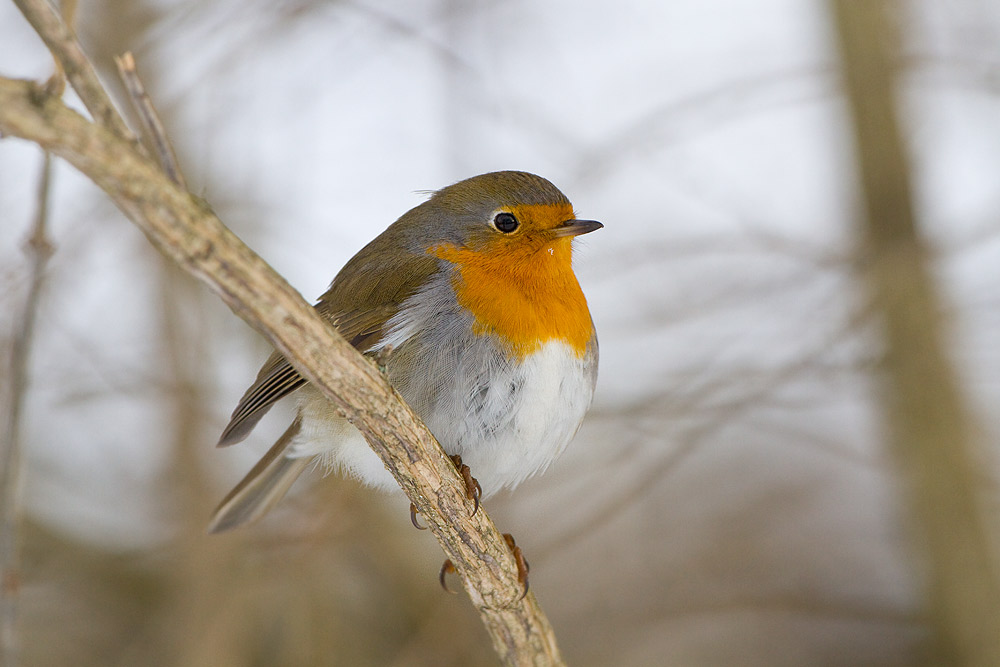
However, bad that accent may be, there is a certain Disney intent to it. There's no need for subtitles or subtlety to sell Van Dyke's chimney sweep to the American ear. It doesn't stop at Dick Van Dyke's cockney, erm, cock-er-ney accent. Ed Wynn doesn't attempt an accent at all; as helium infused hysteric, Uncle Albert, he relies on mere eccentricity to convey that British stereotype. Julie Andrews is so upbeat and energetic, she has the resolve of a Brit, but without the stiffness to her upper lip, she is scrubbed of all notions of the class system with her understandable unspecific accent and good teeth, this makes her practically American. Even the "robin feathering his nest" from A Spoon Full of Sugar is an American Robin, a thrush that bears no resemblance to the British resident European Robin, a smaller flycatcher.
American Robin
European Robin
Perhaps it's directly in keeping with the fantastical nature of P.L. Travers creation, as amped up by Disney, that not only are linguistic conventions, but the nature of nature itself is imprinted with the stamp of American familiarity and forced pronunciation. Even David Lynch caps off his "happy ending" to Blue Velvet with an animatronic cameo of Poppins' avian duet partner.
It is telling that when Disney tried to play much the same game again in Bedknobs and Broomsticks, special effects including live action within animation, leaving more of its Britishness intact, the result was much more humdrum and less successful. And David Tomlinson was given far less to do, even if he received higher billing.
In fact it was on this viewing that I really appreciated that Tomlinson's turn is really the emotional core of the film. His Mr. Banks is the only character that has any kind of arc, his conversion from a stuffy walking bowler hat rack to devil may care kite flyer with a run of wooden leg jokes is the wind changing payoff to the whole film. He hasn't found his inner child as much as submitted to his optimistic inner-American. He is ultimately rewarded by being accepted back into the bosom of his beloved banking establishment. That this invitation to breezily irresponsible banking from the once safe as houses Old Lady of Threadneedle Street, has inevitably destroyed the soundness of the British economy, is a metaphor which I have clearly stretched beyond its breaking point.
Like Disney, I have warped reality to suit my purposes. I'm American, that's what we do.
Back-B-Log: Catch-Up: The Social Network, Worst Films 2010 etc.
I've gotten around to finishing the following articles, and, as I perversely prefer them to be posted to the dates when I more relevantly started writing them, this means they don't show up as the latest thing in the arbitrarily chronological feed.
Also, note, due to my Advent Calendar in Song project in December 2010, going back chronologically may be a bit laborious, you may want to take advantage of the "labels" feature of the blog to see "Reviews" only, for example.
New Forest Film Festival: Project Nim: Responsibility and Mind
The New Forest Film Festival's screening of the excellent documentary Project Nim featured the added value of introduction and then post viewing Q&A with Mike Colbourne, senior keeper at Dorset's Monkey World Ape Rescue Centre, mediated by Film Festival Organizer Linda Ruth Williams. Professor of Film at Southampton University. The film's story of the chimp Nim, taught to sign and used for a spurious experiment to raise him as if he were human, in the context of an extended human family, becomes a vision of a hell paved with good intentions. An absorbing thoughtful film which further elevates the pedigree of director James Marsh (Man on Wire).
There are some slightly artificial illustrative "recreations" that fill gaps in the archive footage, but these do nothing to detract from the air of verisimilitude, whilst giving us the blessed relief of a slight remove from the frankly grim material, a tragedy of errors born of arrogance and self delusion as Nim's "me generation" keepers play an increasingly harmful game of pass the parcel with the hapless animal. Indeed, even the person who comes off best in the film, to the extent that many in the audience consider him the hero of the story, is irresponsible enough to share his recreational drugs with the chimp. Monkey see, monkey dude.
Primate advocates are always eager to stress the notion that the apes are our "closest relatives" in the animal kingdom. This is meant to elicit sympathy, but it also is an own goal because it supports the delusion that we can understand them on human terms. This is a mistake repeated many times throughout the film.
A would be saviour of Nim removes him from one appalling situation, but installs him in isolation, an ordeal for a social animal. A violent incident occurs when a person from much earlier in Nim's story visits and unwisely enters Nim's enclosure. Everyone assumes the attack is based on recognition and a concomitant emotional outburst. In the post film Q&A the primate keeper ascribes it to "frustration". What happens could as easily be a reaction to an intruder on Nim's solitary territory. The problem is we can't fathom Nim's motives, and every time those in his life presume to do so, as well as us, after the fact, he is done a great disservice.
It is not unusual for us to project our own way of thinking onto the actions of animals. We do this all the time, not just with animals, but as we interact with each other, this is called the Theory of Mind (a very good article about how this applies to how we treat our dogs can be found here: slate.com Do Dogs Think?). This is always bound to cause problems as we assume the needs and values of those whose minds we imagine. Nim's story is fraught with the presumptions of his keepers, particularly the notion that just by dressing him up and "raising" him as human, he'd automatically become more like us.
The other problem that Nim encounters is that many of his "benefactors" treat him as a pet. The guest keeper does use the discussion as a platform to highlight a petition to call for a government debate on primate keeping, strengthen the legislation on the control and monitoring of primates in pet ownership (Primates as Pets Petition). Their aim is not to ban ownership, which would drive the trade underground, but to better regulate and institute a proper regime of checks of owners and animal living conditions. In old regime, anyone could own wild animals as pets. The wild animal licensing laws stopped much pet ownership except strangely, smaller primates, which have the same problems of maltreatment. Most primates are social animals, removing them to a human context isolates them and psychologically impacts on them. The fundamental disconnect occurs when owners fail to understand all of the animal's requirements.
This problem is common to owners of standard pets. As a dog owner, and infrequent breeder, whose wife does assessments for a spaniel rescue, I'm used to vetting potential pet owners. This process may seem as intense as an adoption, but it is as important to determine whether they're prepared to take on the consequences of caring, keeping and training their animal throughout its life. When acting as a breeder, the conversation provides scrutiny in both directions. We wouldn't like to place puppies with people who aren't asking the right questions about the needs of their charges.
Many have well meaning but cavalier attitude towards pets, as toys, accessories, or as automatic companions with no inherent needs. For whatever love people may profess towards animals, however deeply felt, we're humans, and we just don't think things through. That cute puppy may be encouraged to jump up, sit on furniture or play tug of war with toys and leads, but when fully grown will suddenly be expected to desist from these behaviours; that sweet chimp approaching adulthood may casually kill other pets and chew half your face off and has the strength to easily maim or kill. That the trajectory of each lifecycle is known and predictable is either wilfully ignored, confounded by irresponsible ignorance or (in the case of photographers who defang chimps for a career in cute "family" photos) managed with intentional mutilation or euthanasia.
Back in the 1980s I had a friend who had looked forward to being a research scientist, had trained for it, and had his first job in a university medical research lab. In an adjacent lab studies were being done with primates, looking into the effect of collisions on the neck and spine. For these simulations chimps and orangutans were accelerated at walls and static objects at various angles and speeds. The injured apes were then diagnosed for how their musculature and vertebrae coped with these injuries. Just being in proximity to this extremity of ethical science made my friend rethink his choice of career. He spoke to me of the flawed grant system which encouraged studies to be proposed almost purely for the sake of generating grant money. Careers constructed around innovative methods of harm with the furthering of science an almost secondary consideration.
I myself am a queasy fencesitter about animal testing, particularly as a son of a Parkinson's sufferer. Mike Colbourne in his introduction was quite honest about diabetes and other conditions that he has that require treatments that most likely were tested on primates in the past, but he pointed out what he has seen of the sharp end, the ex-lab primates that have come to his care physically and mentally distraught. That testing could be used as a last resort only for arguably vital research when other methods are exhausted, is a door that may be left open.
We must remain mindful of our responsibility to the animals, whatever use we put them to. It is responsibility thought through, responsibility acted upon and responsibility seen through, not opposable thumbs, language, abstract thinking, nor other self congratulatory virtues that may truly elevate us amongst the animals, however closely related we may be.
The Last Picture Show as Reviewed By A Critic With an Axe To Grind Over This Gimmick of Black and White
Based on Larry McMurtry's semi-autobiographical novel, and featuring a talented ensemble of both promising unknown newcomers and stalwart character actors, this movie should have been a calling card for up and comer, actor/film critic turned director Peter Bogdonovich. However, all are ill served by the incomprehensible decision to release the film in black and white. This move can only have been driven by "the business", some accountant has worked out that the film can be distributed for less by releasing it on less expensive black and white stock. The cynical studios have the young director, whose career has consisted of Drive-In fodder thus far, naively claiming that the choice was aesthetic, not financial.
Set in a mid-western town during the early 1950's, a time of the birth of rock and roll and lurid red cars with tailfins, it depicts the slow disintegration of a community which abandons its public spaces, pool halls and movie houses, to live in tract house suburbia and watch TV. This was an opportunity to show how much more real, and the style is otherwise very realistic, the lives of genuine people are in natural colour, instead the gimmick of black and white makes the film look like television.
For many years Hollywood has fought a war of attrition with TV, and the popular conceit was that by offering bigger wider screens, better sound, and vivid colour, audiences could be tempted back into theatres. This has not worked, so the suits probably thought, "if you can't beat 'em, join 'em". Although colour TV is now available, more people own black and white than colour, making it the clear preference. The film even has a an aspect ratio half way between Cinemascope and TV. Hollywood's scientific wizards have found a way to port the black and white of television back onto film.
Having presented his television series, Hitchcock famously experimented with this technology, retrofitting Psycho into monochrome to tone down the gore of the shower scene (Michael Powell showed Hitchcock's timidity by releasing Peeping Tom, as it was meant to be, in colour). But Bogdonovich is no Hitchcock.
Bogdonovich claims that his "decision" to use grayscale was commended by his pal, himself once a wunderkind, Orson Welles. The now has-been cigar and cheap chablis shill sleeping on Bogdonovich's couch, whose own exercise in nostalgia, The Magnificent Ambersons, was taken away from him, too late to re-shoot in colour. The studio, concerned that without the period colour, fans of Booth Tarkington's blockbuster best seller, expecting another Gone With the Wind, might react with anger, and indeed the film flopped. Welles has perversely flown the flag for black and white since, and has clearly manipulated his disciple into the same artistic blind alley.
Underneath the dross of this gimmick, there may be a half decent film struggling to get out. The sad failed romance of Sam the Lion, the tragic trajectory of idiot child Billy, Sonny's coming of age reflected in his variable friendship with Duane, his longing for Jacy and his affair with Ruth, should all congeal to some kind of poignancy. But frankly I didn't notice, my eyes were struggling the whole time to try to reintegrate the colour that had been forcibly drained from the images. It is this problem, chromosthesia, that causes headaches in viewers. I may have been able to recommend this movie, if only some cinemas were brave enough to show it in its colour print.
There is a solution to this problem, you can construct your own "colourizing" spectacles. Merely purchase two pairs of sunglasses with polarizing lenses, some wire, a motorized toy car, and some sticky backed plastic. Break one of the sunglasses leaving the lenses separate. Attach the bisected toy car by the axels to the extra lenses, suspending them in front of those of the unbroken sunglasses, using the small motor to rotate them. Other viewers may object to the sound of the motor, but you can cover this up by buying more popcorn and nachos and chewing loudly with an open mouth. Granted, this will not give you true colour, you will see swirls of colour akin to Corman's The Trip, but you can enjoy these to fuller effect if you also smuggle in a cassette player with a tape of Atom Heart Mother, hitting "play" when Cybill Shepherd joins "the club". Finally, place the sticky backed plastic over your mouth to suppress any loud squeals of delight.
Despite the slight dimness caused by the reduction, up to 20%, of what I think they call footchromas, Bogdonovich is sticking to his guns, pledging to shoot Paper Moon in "genuine" monochrome, and rumour has it that Mel Brooks may follow suit with Young Frankenstein. Whatever its good intentions may be, I hope that The Last Picture Show fails to find an audience, as its success would be a prophetic death knell to the industry, making it "the Last", indeed. There is some hope on the horizon as avant garde film-maker George Lucas, who is remaking his enigmatic student film in glorious washed out colour, is considering a look at a similar period as this film, hopefully he'll put the pink Cadillacs and the yellow neon back where it belongs on our nation's screens.
All things to all people and nothing to everybody. A celebration of the warm and fuzzy, or perhaps the cold and indistinct. Lowered responsibilities and diminished expectations. If you haven't the vaguest..... I do! And that's all I will ever assert with certainty. I hope we're unclear about this......
Ex Pat 32 years +, conservation campaigner, film projectionist and critic, unfinished novelist, dog walker, improviser, and obscure database programmer.